




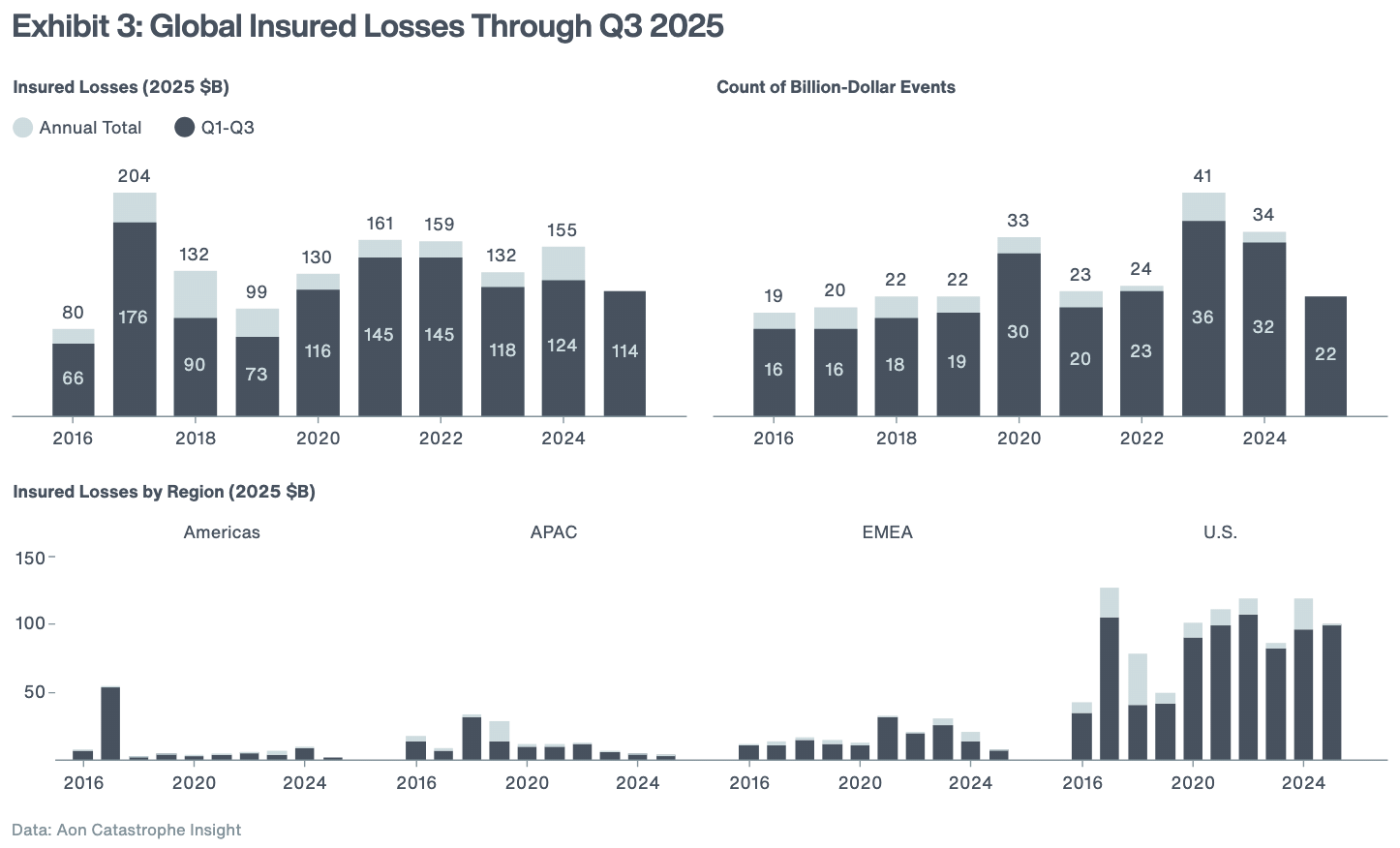
According to insurance and reinsurance broker Aon, global insured losses from natural catastrophes reached $114 billion after one of the lightest (in loss terms) third-quarters in decades, thanks in part to the quiet hurricane season.Economic losses from natural catastrophes in Q3 2025 were “exceptionally low” Aon explained, with global economic losses only hitting $34 billion, which is some 76% below the 21st-century average and the lowest Q3 total in decades.Natural catastrophe losses paid by the global insurance and reinsurance industry in the third-quarter of 2025 only reached $12 billion as a result, which Aon said was the lowest figure for the quarter since 2006.
The Q3 insurance protection gap stood at 66 percent, compared to a 21st-century average of 71 percent, Aon said.For the first nine months of 2025, the insurance protection gap reached just 44 percent, which is the lowest ever recorded for this period thanks to a high share of insured losses occurring in the United States (88 percent), where insurance penetration is higher.Severe convective storms (SCS) were the costliest peril for the first nine months of 2025, with Aon estimating that these events resulted in $57 billion or half of the global insured loss tally and the third highest SCS loss on record for the period.
It’s worth also noting that SCS insured losses reached $10 billion of the overall global Q3 total, so it remains a significant contributor of financial impacts for the insurance industry.The Palisades Fire was the costliest single event, $23 billion in insured losses alone, and contributing to total wildfire industry losses of more than $40 billion.Michal Lorinc, head of Catastrophe Insight at Aon, commented, “The record-low protection gap observed in the first nine months of 2025 highlights the growing role of insurance in helping communities recover from natural disasters.
While this progress has been driven largely by high insurance penetration in the U.S., it underscores the opportunity to expand similar levels of protection globally.“Achieving this requires continued investment in region- and peril-specific tools, collaboration with a broad range of capital providers, and partnerships with governments and other stakeholders to ensure that risk is effectively transferred and managed wherever it exists.” It’s worth noting though, that the location and mix of natural catastrophe or severe weather events is the real driver of the lower protection gap, as in the US insurance penetration is not rising at a particularly fast pace.Also worth considering is how the low level of global losses, with the quiet in loss-terms hurricane season the main driver, means reinsurance sector capital has entered the final quarter of 2025 at a high-level with an expectation of strong full-year earnings that will be rolled into 2026, in many cases.
That goes for traditional reinsurance, catastrophe bonds and private insurance-linked securities (ILS), with all reinsurance exposed strategies currently looking set for another high earnings year, as long as hurricane season doesn’t fire up and no other major losses occur.For comparison to Aon’s Q3 insured cat loss tally of $12 billion and nine month tally of $114 billion, ..All of our Artemis Live insurance-linked securities (ILS), catastrophe bonds and reinsurance can be accessed online.
Our can be subscribed to using the typical podcast services providers, including Apple, Google, Spotify and more.
Disclaimer: This story is auto-aggregated by a computer program and has not been created or edited by Health Insurance USA.
Publisher: Artemis
Publisher: Artemis