







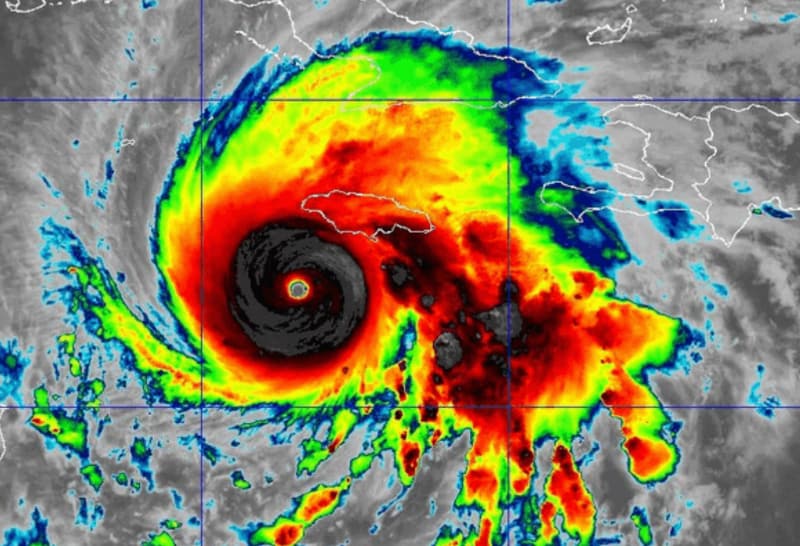
As major hurricane Melissa bears down on the Caribbean island nation of Jamaica, the significant intensity of the storm could activate the country’s parametric catastrophe bond and insurance protection triggers which, should they pay out, will provide a valuable source of financial liquidity and recovery funding at a particularly challenging time for the country.Hurricane Melissa remains a very major storm and is set to potentially become the strongest ever to hit Jamaica.At the latest forecast update from the National Hurricane Center, Melissa had sustained winds estimated around 175 mph, with gusts well over 200 mph and a minimum central pressure last observed as low as 901mb by hurricane hunter aircraft.While our focus is naturally on the risk transfer arrangements Jamaica has prudently put in place given our audience, with the severity of this situation all thoughts must be with the people of Jamaica, who face a historic storm with impacts that could be devastating for areas that receive the brunt of hurricane Melissa’s winds, rains and storm surge.
While the areas around and to the east of landfall will receive the most damaging winds and storm surge, the entirety of Jamaica will be heavily impacted by damaging winds and dangerous leels of rainfall.There is not a great deal to add since .Given the intensity of hurricane Melissa it still appears that Jamaica’s $150 million IBRD CAR Jamaica 2024 parametric World Bank catastrophe bond could be triggered and a payout come due to the nation to aid in its recovery from this disaster.
The cat bond sits at the top of a tower of layered disaster risk financing and parametric insurance arrangements that Jamaica’s government has put in place.The layers beneath the cat bond, which comprise of Jamaica’s natural disaster fund, contingent lines of credit and a range of private risk transfer and parametric insurance from the CCRIF and others, would be expected to be triggered and payout first.The catastrophe bond was always .
The latest forecast data from the NHC continues to show a major hurricane Melissa landfall with sustained winds that could cause extreme damage, and given the current estimated low pressure of the storm this scenario suggests the minimum central pressure may be at levels low enough to trigger the World Bank facilitated catastrophe bond, when it passes through one of the parametric boxes and this may activate a payout.The NHC forecast advisory shows Melissa’s wind speeds slowing slightly as it gets closest to landfall, but potentially still being in the region of 140 mph and the crossing the country with sustained winds of 100 mph or higher.As we’ve explained a number of times, it is the central pressure and location of a hurricane that matters for the cat bond, with Jamaica and the surrounding sea broken into parametric boxes for the IBRD cat bond’s trigger ().
The lowest payout threshold possible is for a 30% triggering of the cat bond notes $150 million of principal.While a more intense storm could cause a full payout just for entering a single box.But, the parametric boxes can also be additive, in that if a storm passes through more than one of them the payout for each can be added together, under certain circumstances.
The current forecast path for Melissa would take it first into the outer parametric boxes first which require a central pressure of 920mb or lower to trigger the cat bond.Parametric boxes closer to shore require a central pressure of 940mb or 960mb and lower, depending on which box Melissa passes through, after which 11 or 12 seem most likely at this time.From previous information we had, around the time of hurricane Beryl in 2024, you can see the box numbers and box pressures here.
On that basis and given the latest forecast this morning, with just a number of hours now until landfall, there remains a strong possibility that Jamaica’s cat bond coverage is activated, with the parametric insurance likely already triggered at that stage.As we understand it, the parametric trigger for the cat bond requires the “b-deck” track data from the Automated Tropical Cyclone Forecast (ATCF) System to be used for the calculation agent process.That data can become available relatively quickly after a storm in some cases, but that is the input required to truly understand whether a trigger event has occurred.
However, the NHC’s landfall pressure report at the time that hurricane Melissa reaches Jamaica’s coast and landfall has occurred should give a reasonable indication whether some kind of payout is likely, or not.Over night, hurricane Melissa travelled further west than the NHC track but has since wobbled back east again and remains roughly on a similar track towards Jamaica as yesterday, perhaps slightly further west which could take the worst impacts further away from some major population centres.Between 9 and 13 feet of storm surge is still anticipated along with rainfall in the tens of inches, while the strongest winds could begin to be damaging for Jamaica within the next few hours and given the still slow pace of the hurricane, Melissa remains an extremely dangerous and historic storm.
For Jamaica, the hope now is that Melissa weakens more than the forecasts suggest as it nears the island and begins to interact more directly with the landmass, as any reduction in the strength of the storm will help to reduce the levels of damage and disruption experienced..All of our Artemis Live insurance-linked securities (ILS), catastrophe bonds and reinsurance can be accessed online.
Our can be subscribed to using the typical podcast services providers, including Apple, Google, Spotify and more.
Disclaimer: This story is auto-aggregated by a computer program and has not been created or edited by Health Insurance USA.
Publisher: Artemis
Publisher: Artemis