







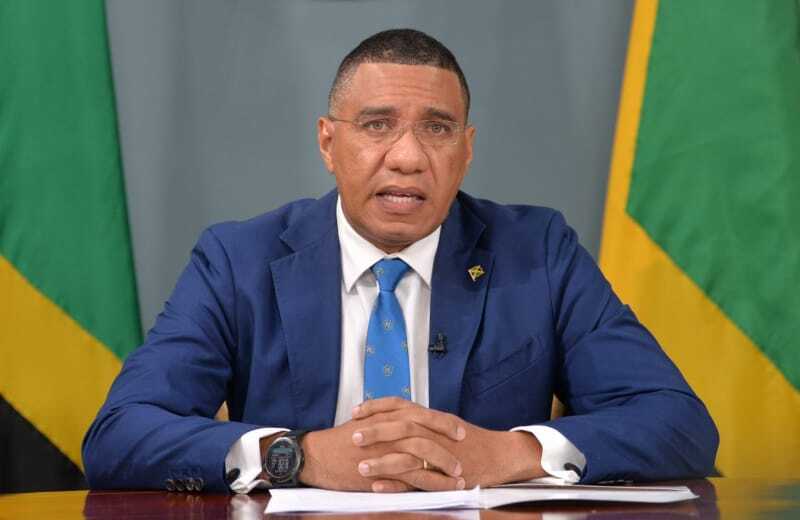
Reflecting on the impacts of Hurricane Melissa, Jamaica’s Prime Minister Dr.Andrew Holness has stressed the importance and effectiveness of responsive disaster risk financing instruments in reducing the country’s debt burden in the aftermath of the hurricane.According to estimates from the World Bank Group, in coordination with the Inter-American Development Bank (IDB), the physical damage to Jamaica caused by Hurricane Melissa totals US$8.8 billion, which is equivalent to 41% percent of the country’s 2024 GDP, making it the costliest hurricane recorded in Jamaica’s history.The World Bank confirmed that the Global Rapid Damage Estimation (GRADE) which was conducted immediately after the hurricane, assessed physical damage across residential, non-residential, infrastructure, and agricultural sectors.
However, the estimation does not include broader economic losses, which are expected to be even more significant.Preliminary findings revealed that 41% of the assessed damages were to residential buildings, 33% to infrastructure, 21% to non-residential buildings, and 5% to the agriculture sector, which includes livestock and related infrastructure.Speaking in Parliament yesterday, PM Holness said: “The authorities administrative expenditure will be financed from the national budget, as other agencies are, however, recovery and reconstruction activities will be financed initially from the National Natural Disaster Recovery Fund, the NNDRF.
“The NNDRF was set up to receive the proceeds of Jamaica’s disaster risk instruments, including Jamaica’s catastrophe bond, policies with the Caribbean catastrophe reinsurance facility CCRIF and various credit contingent claims with the IDB and the World Bank.These amounts will total US $650 million.” Shortly after having its CCRIF parametric tropical cyclone insurance triggered by major hurricane Melissa’s winds, we reported that Jamaica was set to receive a payout under its CCRIF SPC parametric excess rainfall policy, On that same day, the World Bank also confirmed that the of its $150 million IBRD CAR Jamaica 2024 parametric catastrophe bond.This announcement was not particularly unexpected, as just days after Melissa made landfall in Jamaica, PM Holness continued: “It is likely that the government of Jamaica will have to borrow to finance reconstruction beyond what will be available in our NNDRF.
We have immediate access to approximately and please note, I use the word approximately, US $500 million from the IMF Rapid Financing facility the RFI.The RFI facility does not come with policy conditionality, so we will start this reconstruction effort with approximately US $1.15 billion in immediate funds.“This is significant.
To mention this under normal circumstances, it would take us three fiscal years to spend such funds in capital expenditure under normal circumstances.“Just infrastructure there is $2.9 billion of infrastructure damage, that you could say is the government’s responsibility totally.And then there is a part of residential that would be government as well.
And then there is a part of private, meaning private homes and private facilities that government may also have to assist.And then there is the relief and the recovery expenditure.” Adding: “So we have here a total of US $1.15 billion, a part of it is the insurance and the contingencies that we have, and a part of it is immediately accessible debt that we could start but just from the assessment here, which is not the final assessment.“You know, there’s $8.8 billion of damage for which the government would more likely be responsible for at least half.
So, there is still a gap that will have to be funded, and that will have to be funded by additional borrowing.” It’s important to remember that if it were not for the $650 million that Jamaica will receive from the cat bonds, parametric insurance from the CCRIF and other contingent disaster risk financing instruments, the government would have needed to borrow that sum as well.This would have increased the country’s debt burden and worsened its debt to GDP ratio.“The government has to be frugal.
It has to be careful.It has to watch no more than ever.It has to watch every dollar that is spent,” PM Holness said.
Concluding: “Because, yes, we are in a good position.No doubt, we have never been in a position when a disaster struck.And we don’t have to be scrounging around to find $1.15 billion, we have it there to start.
“That is because of the fiscal management of the government that builds resilience in our fiscal affairs.” Previously, debt had always been the default answer for countries recovering from natural disasters.But increasingly layered approaches to disaster risk financing, across all forms including insurance products, is becoming a valuable way to decrease the debt burden post-event, by planning before the worst happens.There is, of course, nothing wrong with debt arrangements, as long as the overall financing structure for an economy is considered, with costs and the responsiveness of different instruments well thought through.
– .– .– .
– .– .– .
– – – – .All of our Artemis Live insurance-linked securities (ILS), catastrophe bonds and reinsurance can be accessed online.Our can be subscribed to using the typical podcast services providers, including Apple, Google, Spotify and more.
Disclaimer: This story is auto-aggregated by a computer program and has not been created or edited by Health Insurance USA.
Publisher: Artemis
Publisher: Artemis