


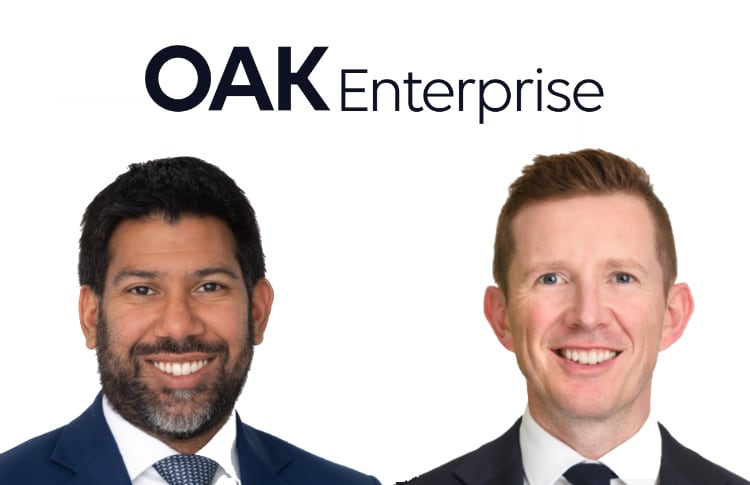
Having recently launched the OAK Enterprise retrocession focused Syndicate 1440 at Lloyd’s, executives from the company spoke with Artemis to discuss the opportunity they see in writing retro with the backing and support of third-party capital investors, as well as use of the London Bridge ILS structure to channel funding.As we reported last month, .Syndicate 1440 has been backed by a range of investors, at least one of which funded its commitments through the Lloyd’s insurance-linked securities structure London Bridge 2 PCC.Roland Morse, Chief Underwriting Officer, OAK Enterprise and Deepon Sen Gupta, Head of Capital Partnerships, OAK Global sat down with Artemis to explain more about the strategy, the benefits of leveraging the Lloyd’s platform to access retrocession-linked returns, how investors and clients responded to the new OAK venture, and the use of an ILS structure to fund some of the syndicate’s capital commitments.
OAK Enterprise CUO Roland Morse told us why the OAK Enterprise strategy is viewed as a timely launch.“What we’re seeing is that buyers of reinsurance have increasingly transitioned from regional, line of business focused purchasing towards centralised and strategic capital management at a group level.In some cases that is inclusive of protecting their reinsurance portfolios and those risks cannot currently be serviced by OAK Reinsurance.
The launch of OAK Enterprise through Syndicate 1440 caters to this demand,” Morse explained.“Retro is also an attractive segment of the of the global (re)insurance value chain, and offers investors attractive returns over the cycle, but is an area that requires dedicated expertise, capital and analytical resource.So, there are barriers to entry as such.” Morse acknowledged the softening market will of course be evident in retrocession, but that rates remain attractive.
He told us that, “Despite the current downward pressure on rates that we’re anticipating at 1st of January, it is still an opportune time to enter the retro market with robust attachment points, a healthy rating environment, and strong discipline around terms and conditions that flows through the industry.“That said, our objective is not to time the market, but rather to develop a portfolio strategy and a market position that will produce a highly profitable portfolio for investors alongside attractive solutions for target clients over the long term.” Moving on to explore the investor side of the strategy, Deepon Sen Gupta, Head of Capital Partnerships for OAK Global told us that the response and been positive and there are a number of elements to the strategy that help to differentiate it from other retrocessional reinsurance-linked investment opportunities.“We announced our in-principle approval just before Monte Carlo, and the feedback from both clients and investors has been overwhelmingly positive.
Investors see a broad range of investment opportunities to pick from, many of which will include ILS funds, and investors we’ve spoken to have been really impressed by the OAK Enterprise proposition and there’s a few different parts to that,” Sen Gupta told us.Going on to explain some of the reasons for that positive response, Sen Gupta continued, “Number one, market conditions remain very attractive, there’s been a reset in pricing and attachment points post-hurricane Ian and whilst rates might be coming off all-time highs, they’re still at historically attractive levels, and importantly, discipline on attachment points remains.You’re being paid more to operate at a more risk-remote level than previously.
“In terms of the strong market profile of the OAK team and our retro expertise, we have an incredible team here at OAK Global, and this includes market leading retro underwriting expertise.This talent has deep relationships and knowledge of the buyers and distribution, as well as experience of structuring and pricing retro deals.“A dedicated Lloyd’s syndicate offering highly-rated paper increases attractiveness to clients, and retro buyers are increasingly looking to diversify their panels away from a relatively concentrated retro market.
So, Lloyd’s capacity is being seen as attractive and accretive to them, and rated paper also offers us the ability to carefully construct a diversified portfolio without taking outsized positions on individual risks or peak exposures.“All of that culminates in the ability to underwrite an attractive portfolio and deliver strong returns to investors.And if you think about where retro sits in the insurance value chain, the level of data and that kind of connection with the underlying risk does reduce as you get more risk remote.
So, you do need the underwriting expertise to really understand these risks, and there has to be an expected margin to compensate for this fact.So, the expected margin on retro business is attractive, but it also does come with a greater level of volatility and a greater capital consumption as well.” Sen Gupta also explained the profile of the OAK Enterprise investor base, which spans the more traditional sources of Lloyd’s capital as well as third-party investors you might just as typically see allocating to an ILS fund.Sen Gupta said, “Building a dedicated Lloyd’s syndicate shows our conviction in the long-term strategy and our ability to deliver sustainable returns for investors over the cycle whilst providing meaningful capacity to clients.
“Given the inherent volatility associated with retro, we believe that having a diversified investor base provides a stable source of year-on-year capital support, but also resilience in the event of loss activity.We already have a broad mix of investors spanning from traditional Lloyd’s Names, to trade reinsurers, but also financial investors.This is very much being done by design, as we want to minimise the impact of systemic issues impacting specific cohorts of investors and as we grow the syndicate and as market opportunities present themselves, we will absolutely expand our capital partnerships further and aim to deliver attractive return to our investor partners.
“The new entrance process at Lloyd’s was intensive and rigorous but their support also signifies the trust they are placing with us to be able to execute this strategy.” CUO Morse then exlained more about the product mix within retrocession that OAK Enterprise intends to write, as well as its goal to be a long-term trading partner for reinsurers seeking retro protection.“We are offering a range of both property and specialty retro products.The portfolio will incorporate elements of diversification by class of business, underlying portfolio mix, structure (severity or frequency) and geography.
Aligned with Lloyd’s rated paper, and as part of the broader OAK Global offering, that’s something that we see as somewhat unique and highly valued by the leading buyers of retrocession,” Morse said.Adding that, “By bringing a compelling product and trading relationship to our prospective clients and brokers we will also be well positioned to deliver strong returns to investors throughout the cycle.So, the two really go hand in hand, and those sustainable partnerships are central to our strategy.
Structures, products and pricing will move, there will be give and take, but the objective will be to trade with core clients over time.” Morse further stated that, “So far, the reception from the market has been extremely positive, with clients and brokers welcoming additional London and Lloyd’s leadership.” He also explained the outlook for retrocession around the end of year renewals and into 2026.“It’s too early in the retro renewal to comment specifically on direction of travel as the market is running late,” Morse explained, “but we are anticipating downward pressure on rates in the retro space, as we are across the majority of reinsurance classes.“But what’s encouraging is a discipline that we’re seeing in terms of the market offering affirmative, rather than open-ended coverage, and with buyers remaining focused on that quantifiable coverage as well.” Moving back to Sen Gupta, we discussed the investor motivations for supporting the latest OAK syndicate, as well as the use of Lloyd’s ILS structure to fund part of the investor commitments.
Sep Gupta highlighted a number of reasons third-party investors have supported OAK’s latest venture, “At OAK Global we’re combining science, data driven analytics and extensive underwriting expertise to address the evolving risk landscape.We have an opportunity to create a holistic industry data set across the reinsurance value chain, and this enables us to have a unique view of the market, but it will also help us to provide holistic solutions to clients and ultimately make better risk decisions.“As a startup, we’re not hampered with legacy systems, and we’re being very thoughtful around the opportunity that having a greenfield site gives us.
So, we’re designing a technology-forward business model, harnessing data and best-in-class risk analytics.“If you couple that with the structuring and underwriting expertise, through the fantastic team that we’ve managed to attract, we can overlay our underwriting expertise, but also our own proprietary view of risk when analysing each and every deal, to carefully construct a diversified portfolio of risk and managing it accordingly to deliver strong underwriting returns for our investor partners.” On the use of the London Bridge 2 PCC structure to channel investor commitments to retro Syndicate 1440, Sen Gupta said, “We view London Bridge as a very positive and accretive complement to the Lloyd’s Capital Framework.When we were considering about how we should structure OAK Enterprise, a standalone Lloyd’s syndicate was our desired outcome and part of that was the ability to collateralize the portfolio to the 1-in- 200 and ultimately obtain an A+ rating via Lloyd’s, versus fully collateralizing individual deals, as you would have to for one-shot covers.
“Given the Lloyd’s three-year accounting, it means that investors can avoid having trapped collateral, with that capital able to support multiple underwriting years.There’s clearly a tax transparency associated with London Bridge too, which institutional investors, financial investors are increasingly attracted to.“In addition, Lloyd’s has well-established commutation mechanisms of the reinsurance-to-close mechanism, and that gives investors finality and certainty.
“The strong regulatory oversight from Lloyd’s does provide investors with additional comfort over how their capital is being deployed and the London Bridge 2 structure also facilitates the ability to have that diversified investor base without having to create fund infrastructure or commingling of funds.“Add in the additional overlays of an investor being able to participate on multiple different syndicates, you get capital diversification benefit from the complementary risk profiles of those underlying portfolios.If you also consider the ability to use leverage to fund part of your capital requirements, it can be really attractive for investors.” ..
All of our Artemis Live insurance-linked securities (ILS), catastrophe bonds and reinsurance can be accessed online.Our can be subscribed to using the typical podcast services providers, including Apple, Google, Spotify and more.
Disclaimer: This story is auto-aggregated by a computer program and has not been created or edited by Health Insurance USA.
Publisher: Artemis
Publisher: Artemis