







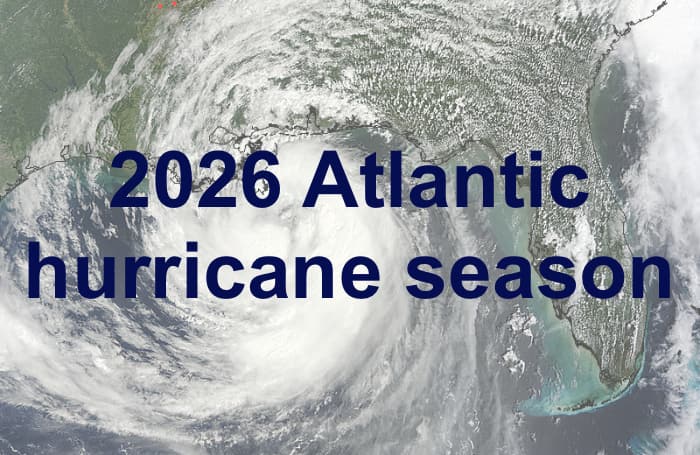
The will be shaped by shifting climate patterns in the Pacific, as a developing El Niño may influence and perhaps depress tropical storm formation, but a forecast from Accuweather highlights the potential for rapid intensification and warns of three to five direct storm impacts on the United States.Waters are already warm in the Atlantic, Caribbean and Gulf in regions where early tropical storm formation has tended to occur, which leads Accuweather to forecast a chance of an earlier start to the 2026 Atlantic hurricane season.As a result, “It may not take much to have tropical activity fire up around the same time that the season officially gets underway,” Accuweather explained.Adding that, “The early part of the hurricane season is when “homegrown development” is most frequent.
This can happen if a storm or front that moves across North America stalls over the Gulf, western Caribbean or western Atlantic Ocean.As it sits over warm water, it may eventually transform into a tropical depression, tropical storm or even a hurricane.“When storms develop so close to land, it means there is less time for coastal residents to prepare for potential impacts.” But, El Niño conditions are expected to be the main influence to the overall season in terms of hurricane and storm formation, meaning storm numbers may be around or even below historical averages, Accuweather explains.
As a result, the Accuweather early forecast for 2026 Atlantic tropical storm and hurricane activity calls for 11 to 16 named storms, with between four to seven hurricanes and two to four intensifying to become major hurricanes of Category 3 or higher.In addition, Accuweather forecasts between three and five direct storm impacts on the United States in the 2026 hurricane season, although these could be named tropical storms or stronger.However, they also explain that, “A direct impact to land can occur even if a storm doesn’t make landfall.
It can also include tropical-storm-force winds reaching land, flooding rain from a storm just offshore, or a storm surge of at least 2 feet along the coast.” While El Nino is expected to continue developing, some forecasts suggest it could be quite strong by later in the year, and this can depress storm formation it does not mean the season will be uneventful in human and financial impact terms.Just one storm can cause severe impacts to lives and livelihoods, as well as to insured and uninsured assets.It’s an average to slightly below-average seasonal forecast from Accuweather for 2026.
But as we always caution it only takes one major storm to make landfall in a region of high coastal exposure concentrations and values, for their to be impacts to the insurance, reinsurance, catastrophe bond and insurance-linked securities (ILS) markets.Commenting on expectations for ENSO conditions through 2026, Accuweather’s forecasters said, “With El Niño forecast to develop and strengthen throughout the summer and autumn, it is likely to translate to fewer storms during the second half of the hurricane season compared to the first half.“There is about a 15% chance that a “super El Niño” will develop if ocean temperatures near the equator of the eastern Pacific rise at least 2 degrees Celsius (3.6 degrees Fahrenheit) above long-term averages.
If it does happen, it could sharply reduce storm activity in late October and November.” There was last an El Niño during the Atlantic hurricane season in 2023, which still ended up being a busier season than normal with 20 named storms.“What made 2023 very special is it was also the warmest year on record if we take a look at the average sea surface temperatures across the Atlantic basin,” AccuWeather Lead Hurricane Expert Alex DaSilva explained.Atlantic sea surface temperatures are expected to be warm throughout 2026, but not quite as high as in 2023.
Going into more detail on some of the forecast conditions for the 2026 hurricane season, rapid intensification is again a concern.“This year we are very concerned about rapid intensification, very similar to the last couple of years,” DaSilva said.This is not just due to sea surface temperatures, but also the deep pools of water hurricanes can feed off.
“Those waters are also exceptionally, exceptionally warm,” DaSilva said, “That is why once again we are very concerned about rapid intensification this upcoming hurricane season.” Accuweather sees the northern and northeastern Gulf Coast and the Carolinas as the regions most at-risk of impacts from tropical storms or hurricanes in 2026.Finally, Accuweather also highlights the position of the Bermuda high for 2026, saying it may be quite similar to last year, which can allow more storms to curve away from the US, another factor to watch out for when storm tracks are available for any developing depressions.It’s worth also noting the latest tropical conditions forecast from early March by the ECMWF, which for the period up to September is now calling for 11.6 named storms in the Atlantic basin, with 4.7 hurricanes.
In addition the ECMWF calls for accumulated cyclone energy (ACE) levels to be around 20% below the climate norm.We can compare these more recent forecasts to the pre-season forecast from Tropical Storm Risk (TSR), which .At longer-lead times season hurricane forecasts are not given an enormous amount of weight by constituents in the reinsurance, catastrophe bond and ILS market.
But they are directionally helpful, especially when it comes to expectations for sea surface temperatures (SST’s), the state of ENSO and any expectations for El Nino or La Nina, as well as thoughts on steering currents etc.We will be tracking the tropics as the season begins and have now set up our typical page, which will be updated as more forecasts are released and when any tropical storm activity occurs.– .
– .– ..All of our Artemis Live insurance-linked securities (ILS), catastrophe bonds and reinsurance can be accessed online.
Our can be subscribed to using the typical podcast services providers, including Apple, Google, Spotify and more.
Disclaimer: This story is auto-aggregated by a computer program and has not been created or edited by Health Insurance USA.
Publisher: Artemis
Publisher: Artemis